
A Victory Written in Courage
In June 1942, the future of the Pacific hung in the balance. Only six months after Pearl Harbor, the Imperial Japanese Navy moved toward Midway Atoll with a bold plan: seize the island, draw out the weakened U.S. Pacific Fleet, and push American power back across the ocean. What Japan found instead was a nation that had absorbed the blow, studied the enemy, broken the code, and sent its sailors and aviators forward with the confidence of a free people who refused to yield.
The Battle of Midway was fought from June 3 to June 7, 1942, across a vast stretch of ocean. American forces went into the fight outnumbered in key ways, with no battleships in the carrier striking force, only three carriers: USS Enterprise, USS Hornet, and USS Yorktown, along with a command team that understood timing, intelligence, courage, and initiative could change history.
That is what Midway became: an American victory built by codebreakers, commanders, mechanics, deck crews, Marines, sailors, and aviators who proved that American exceptionalism is more than a phrase. It is action under pressure. It is discipline in the face of fear. It is the willingness to rise when the nation calls.

Before the Battle: America Breaks the Enemy’s Plan
The road to victory began before the first aircraft launched. U.S. Navy cryptanalysts had been working to break Japanese communications. They identified that the enemy was preparing to attack a target called “AF,” then confirmed “AF” was Midway by having the island send a false message about a shortage of fresh water. When Japanese communications repeated that “AF” was short of water, Admiral Chester W. Nimitz had the confirmation he needed.
This was American ingenuity at war. While Japan expected surprise, the United States turned intelligence into strategy. Nimitz moved the carriers USS Enterprise, USS Hornet, and USS Yorktown into position northeast of Midway. Yorktown had been damaged at Coral Sea, but American shipyard crews at Pearl Harbor performed a near-miracle to get her back into the fight. The fleet was wounded, but it was ready.
June 3, 1942: The First Contact

The battle began before the carrier duel. On June 3, a Consolidated PBY Catalina patrol aircraft (PBY) flying from Midway spotted part of the Japanese occupation force southwest of the atoll. American land-based aircraft attacked that force, including Boeing B-17 Flying Fortress bombers and PBYs carrying torpedoes. The results were limited, but the message was clear: Midway was alert, armed, and ready.
That first contact mattered. The defenders of Midway were not passive targets waiting for rescue. They were the forward edge of America’s answer. Marines, sailors, soldiers, and aviators on that tiny Pacific outpost stood their ground and forced the enemy to fight for every mile of ocean.

June 4, 1942: The Enemy Strikes Midway
On the morning of June 4, Japanese carrier aircraft attacked Midway. They damaged the base, but they did not destroy it. Midway’s defenders endured the assault, kept fighting, and bought precious time for the American carrier force to the east: United States Ship (USS) Yorktown (CV-5), USS Enterprise (CV-6), and USS Hornet (CV-8).
The American carriers launched Douglas TBD Devastator torpedo bombers (TBD), Douglas SBD Dauntless dive bombers (SBD), and Grumman F4F Wildcat fighters (F4F) toward the Japanese fleet. The attacks that followed were costly, chaotic, and heroic. They became one of the most dramatic displays of courage in American military history.

John C. Waldron and Torpedo Squadron Eight
Lieutenant Commander John C. Waldron, commanding Torpedo Squadron Eight (VT-8) from USS Hornet, led fifteen TBD Devastators into the fight. Waldron believed the main strike group was on the wrong course, broke away, and led his squadron toward the Japanese carriers. VT-8 found the enemy and attacked without effective fighter cover. Every plane was shot down. Ensign George Gay was the only survivor from the thirty men who launched from Hornet with VT-8 that morning.
Waldron’s attack did not sink a carrier, but his courage mattered. The smoke generated by VT-8’s attack led Eugene Lindsey to the Japanese and more importantly forced the Japanese to delay movement of their Strike aircraft to their flight decks. Had the Japanese been able to launch a strike on the outnumbered American carriers the battle would have been lost in one stroke. Waldron and his men flew into almost certain death because the mission mattered more than survival.

Eugene E. Lindsey and Torpedo Squadron Six
Lieutenant Commander Eugene E. Lindsey, commanding Torpedo Squadron Six (VT-6) from USS Enterprise, had already suffered a dangerous landing accident days before the battle. His TBD Devastator crashed while attempting to land on Enterprise on May 28, 1942, and he had to be rescued by USS Monaghan (DD-354). Lindsey suffered broken ribs, a punctured lung, a badly sprained back, and multiple bruises and lacerations, Spending the next several days in sickbay, his body wrapped in tape, he limped to his aircraft and had to be helped into its cockpit.
On June 4, Lindsey led VT-6 into a torpedo attack against the Japanese carrier force. He pressed home the attack through intense anti-aircraft fire and fighter opposition. Lindsey was killed in action, and VT-6 suffered devastating losses. His example was pure American resolve: injured, outmatched, and facing terrible odds, he still led from the front. 10 of 14 aircraft were lost along with their aircrew. Although none of VT-6s torpedoes hit the Japanese had to use their flight decks to recover, rearm, refuel, and relaunch their Zero Combat Air Patrol. As had happened with VT-8s attack this prohibited the Japanese from launching a strike against our carriers.

Lance E. Massey and Torpedo Squadron Three
Lieutenant Commander Lance E. Massey, commanding Torpedo Squadron Three from United States Ship Yorktown, entered the fight after the earlier torpedo squadrons had already drawn blood from the enemy’s fighter defense with their own lives.
As Massey and his men approached the Japanese carrier force, the battlefield was changing by the minute. American dive bombers were beginning to fall upon Akagi, Kaga, and Soryu. But one Japanese carrier still remained untouched: Hiryu.
Massey could have driven his squadron toward a closer target. Instead, he made the harder decision. He turned toward Hiryu, the farthest and still-unattacked carrier, even as she steamed away at high speed. That choice forced Torpedo Squadron Three into a longer, more punishing approach through enemy airspace. Accounts place the Japanese fighter opposition at roughly thirty or more Zero fighters, with some accounts estimating as many as thirty-six to forty-three. Massey led his squadron forward anyway.
It was a decision that almost certainly doomed his squadron, but it also reflected the highest form of naval leadership. Massey saw the carrier that still posed a threat, chose the target that mattered, and pressed the attack against terrible odds. His TBD Devastators were slow, vulnerable, and outnumbered, but they forced Hiryu and her fighters to stay engaged at the moment America’s dive bombers were delivering the decisive blows elsewhere.
Massey was killed while leading from the front. His attack did not sink Hiryu, but it helped hold the enemy’s attention, stretch the Japanese fighter defense, and keep pressure on the last carrier still capable of striking back. In the story of Midway, Massey’s choice deserves to be remembered not as a failed torpedo run, but as an act of battlefield judgment, sacrifice, and courage. None of Massey’s 12 aircraft returned from this mission with the loss of 21 aircrew.

C. Wade McClusky Finds the Enemy
Commander C. Wade McClusky, air group commander from USS Enterprise, made one of the most important decisions of the battle. After his SBD Dauntless dive bombers failed to find the Japanese carriers at the expected location, fuel was running low. Turning back would have been understandable. McClusky kept searching.
He spotted the Japanese destroyer Arashi racing north after attacking the American submarine USS Nautilus (SS-168). McClusky reasoned that Arashi was heading back to the Japanese carrier force, followed its wake, and led American dive bombers directly to the enemy. That decision helped deliver the decisive blow at Midway. McClusky’s judgment, persistence, and refusal to quit turned empty ocean into opportunity. In that moment, American initiative changed history.

Richard H. Best and Bombing Squadron Six
Lieutenant Richard H. Best, commanding Bombing Squadron Six (VB-6) from USS Enterprise, became one of the central figures in the destruction of the Japanese carrier force. During the morning attack, Best recognized confusion in the targeting of the Japanese carriers and shifted his attack toward Akagi. His bomb helped doom one of the most important carriers in the Japanese fleet.
Later that same day, Best participated in the attack on Hiryu, the last surviving Japanese carrier still capable of striking back. Best hit two Japanese carriers in one day, a feat that stands among the most remarkable achievements in naval aviation. His final battle also cost him his flying career after he suffered serious lung damage connected to the mission.

Max F. Leslie and Bombing Squadron Three
Lieutenant Commander Max F. Leslie, commanding Bombing Squadron Three (VB-3) from USS Yorktown, led his SBD Dauntless dive bombers against Soryu. Just before the attack, Leslie and several other pilots accidentally lost their bombs because of an arming problem. Leslie could have pulled away. Instead, he continued leading his squadron into the dive.
His leadership helped VB-3 score devastating hits on Soryu. Even without a bomb of his own, Leslie stayed in the fight, led his men through enemy fire, and helped destroy another Japanese carrier. His courage was leadership in its purest form: the commander goes first, even when the odds are terrible and even when his own weapon has failed. Returning from the strike Leslie circled over several ditched aircraft enabling their rescue until his fuel gave out and he had to ditch himself.
The Turning Point

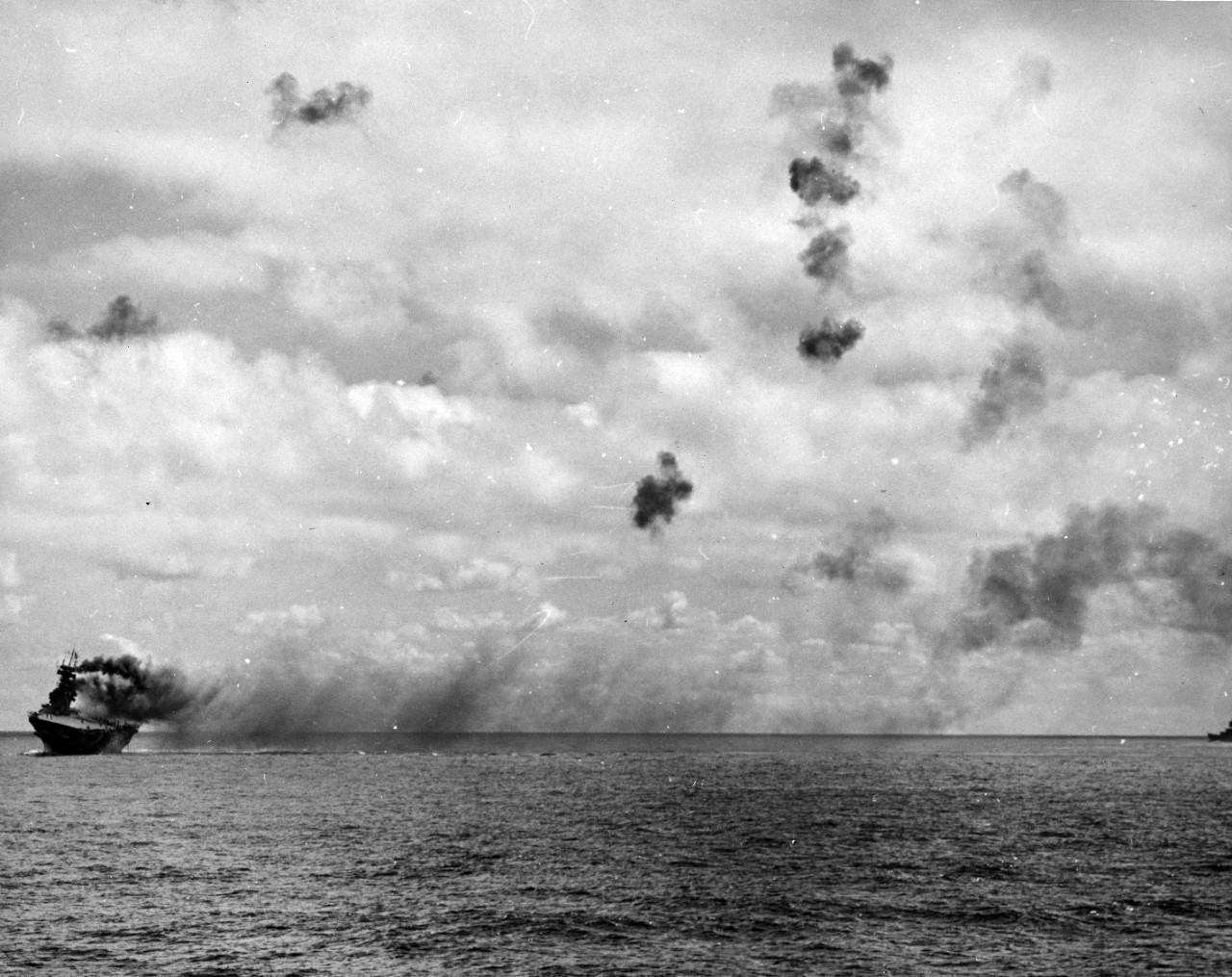
In a matter of minutes on June 4, American dive bombers turned the battle. Akagi, Kaga, and Soryu were left burning. Hiryu, the last operational Japanese carrier, struck back and badly damaged Yorktown, but later American strikes hit Hiryu as well. By the end of the battle, Japan had lost all four carriers committed to the operation: Akagi, Kaga, Soryu, and Hiryu.
The battle continued through June 5, June 6, and June 7. American aircraft attacked retreating Japanese forces, sinking the heavy cruiser Mikuma and damaging other ships. USS Yorktown, already wounded, was later torpedoed by a Japanese submarine along with USS Hammann (DD-412). Yorktown finally rolled over and sank on June 7.
The victory came at a terrible price, especially for the torpedo squadrons. By one combined tally of the carrier and Midway-based Navy torpedo aircraft, forty-two of the forty-seven torpedo bombers that launched into the battle failed to return to their carriers or to Midway. Only eighteen of the one hundred men who crewed those aircraft survived the battle.
Those numbers tell part of the story, but not all of it. The torpedo bombers attacked low, slow, and exposed, directly into Japanese fighters and anti-aircraft fire. Their torpedoes did not sink the enemy carriers that morning, but their sacrifice helped create the opening that changed the battle. They pulled Japanese fighters down toward the water. They forced the carriers to maneuver. They disrupted the enemy’s timing. They kept the pressure on until American dive bombers arrived overhead. National World War II Museum and Navy historical accounts emphasize that the torpedo attacks drew Japanese fighters low and helped open the sky for the decisive dive-bomber attacks that followed.
The dive bomber losses were significant as well, and many brave SBD Dauntless crews failed to return. But the torpedo squadrons suffered a distinct kind of destruction. Their losses came overwhelmingly under direct enemy fire while pressing attacks that every man knew might be one-way. They went anyway. That is why Midway cannot be told only as a story of bombs hitting decks. It must also be told as a story of Americans who attacked first, absorbed the enemy’s fury, and helped make victory possible.

Why Midway Still Matters
Midway changed the war in the Pacific. The victory destroyed four Japanese carriers that had participated in the attack on Pearl Harbor. Japan could not easily replace the carriers, aircrews, and experienced pilots it lost. After Midway, the Japanese offensive in the Pacific was overturned, and the United States began moving toward the offensive. But Midway was more than a strategic victory. It was a national statement.
It showed what happens when American intelligence, American industry, American training, and American courage converge at the decisive point. It showed that free men, properly led, can stand against an empire and win. It showed that the American spirit is not built on perfect conditions. It is built on action under pressure.
The Midway 6 embodied that spirit. Waldron, Lindsey, and Massey drove into the teeth of the enemy. McClusky searched beyond the expected and found the decisive opening. Leslie led even after losing his own bomb. Best struck with precision and courage when history demanded it. Their actions helped save Midway, defend the Pacific, and change the course of World War II.
The Honor Still Owed
The Battle of Midway produced one Medal of Honor: Captain Richard E. Fleming of the United States Marine Corps, awarded posthumously for his actions after attacking Japanese ships from Midway Island. Naval History and Heritage Command notes that only one Medal of Honor was awarded for the entire battle, while approximately 170 Navy Crosses were awarded to Navy personnel, many of them aviators and many of them posthumous. That fact deserves attention.
World War II produced hundreds of Medals of Honor across the Army, Army Air Corps, Marine Corps, Navy, and Coast Guard. A congressional research table lists 331 Army awards, 82 Marine Corps awards, and 57 Navy awards for World War II, with Army Air Corps awards counted under the Army. Of those Navy Medals of Honor, fifteen were awarded for Pearl Harbor alone. Reporting on the current Midway Six effort has noted that those Pearl Harbor awards created backlash among military and political leaders over how many Medals of Honor had been awarded for a disastrous opening attack. Then came Midway.
At Midway, Navy aviators changed the course of the Pacific War. They attacked through overwhelming opposition. They found the enemy when failure seemed certain. They turned obsolete aircraft, damaged bodies, failing fuel, and impossible odds into a victory that helped save the Pacific. Yet no Navy Medal of Honor was awarded for the battle. That absence is not a small footnote. It is the reason this campaign exists.
Commander C. Wade McClusky, Lieutenant Commander Max F. Leslie, Lieutenant Commander Eugene E. Lindsey, Lieutenant Commander Lance E. Massey, Lieutenant Commander John C. Waldron, and Lieutenant Richard H. Best represent the kind of courage the Medal of Honor was created to recognize. Their actions were not symbolic. They were decisive. Their heroism was not ordinary bravery under fire. It was gallantry above and beyond the call of duty at one of the most important moments in American military history.
America won at Midway because men like these refused to turn away. Now America has the chance to make the record right.
Help Honor the Midway 6
Commander C. Wade McClusky, Lieutenant Commander Max F. Leslie, Lieutenant Commander Eugene E. Lindsey, Lieutenant Commander Lance E. Massey, Lieutenant Commander John C. Waldron, and Lieutenant Richard H. Best represent the best of the United States Navy and the best of the American fighting spirit.
Their story deserves to be remembered. Their courage deserves to be taught. Their record deserves the highest national review. HonorAmericanHeroes.org exists to carry their legacy forward and call for proper recognition of the Midway 6 through the Medal of Honor.