
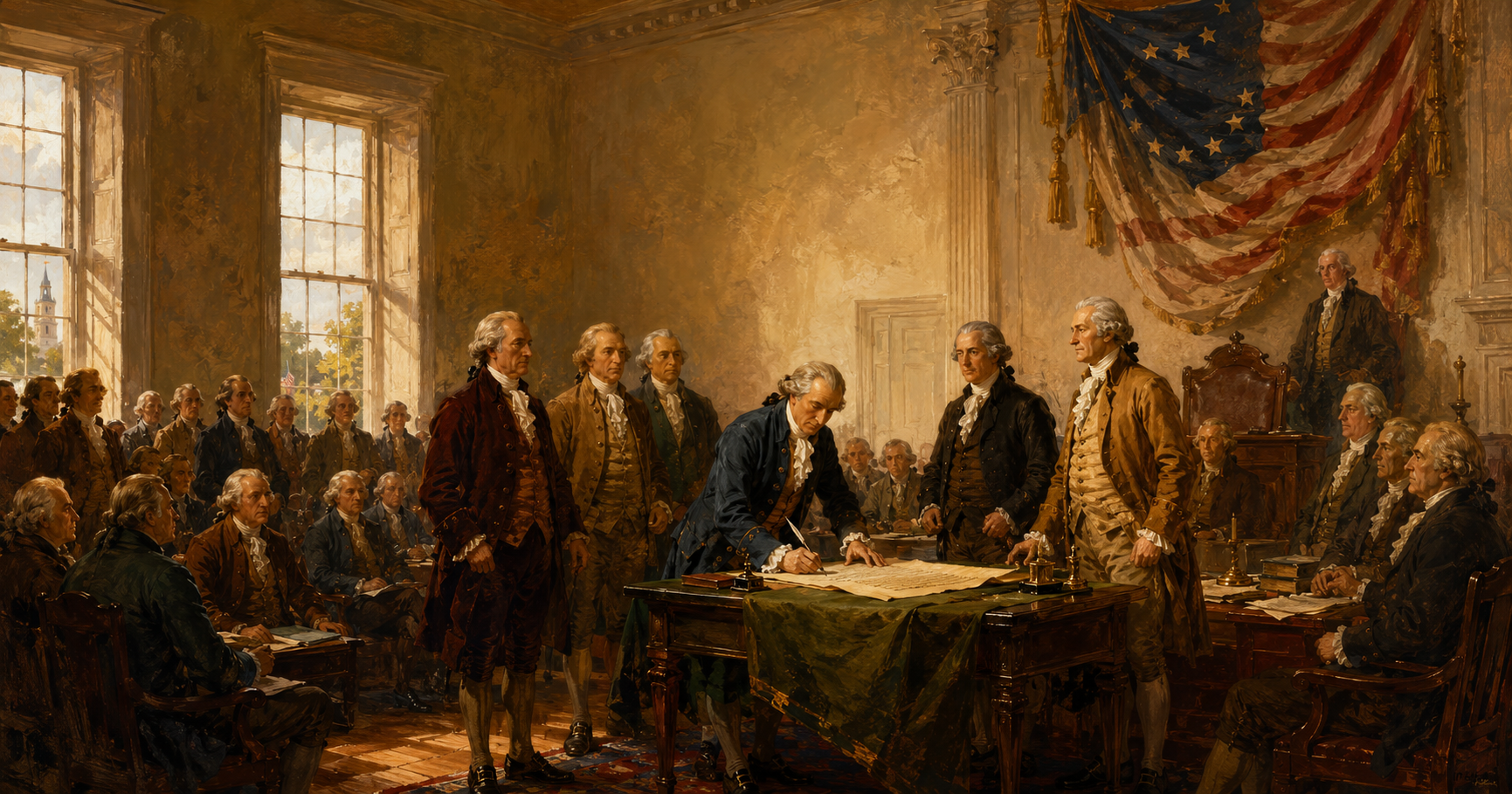
Every Fourth of July, Americans celebrate more than fireworks, parades, and flags. We celebrate the moment a brave group of patriots declared to the world that liberty was worth the cost, that a free people could govern themselves, and that America would no longer bow to tyranny.
The first Independence Day was not born in comfort. It was born in uncertainty, danger, and conviction. The men who gathered in Philadelphia in 1776 were not signing a ceremonial document. They were risking their lives, their fortunes, their families, and their futures.
They knew exactly what they were doing.
By signing the Declaration of Independence, they were committing an act of open defiance against the most powerful empire on earth. Had the American Revolution failed, their names would not have been remembered as Founding Fathers. They would likely have been hunted as traitors.
Instead, they became the men who helped give birth to the United States of America.
The Road to July 4, 1776
By the summer of 1776, the American colonies had already reached a breaking point. For years, tensions had grown between the colonies and Great Britain. The colonists had protested taxation without representation, the overreach of royal authority, the presence of British troops, and the denial of rights they believed belonged to them as Englishmen and as free people.
The battles of Lexington and Concord had already been fought. American blood had already been spilled. The colonies were no longer merely debating policy. They were facing the hard reality that liberty might require independence.
On July 2, 1776, the Continental Congress voted in favor of independence. Two days later, on July 4, Congress formally adopted the Declaration of Independence. That is the date Americans have honored ever since as the birth of the United States.
It was not just a political statement. It was a moral declaration. It announced that human beings are endowed by their Creator with unalienable rights, that governments exist to secure those rights, and that a people have the right to change or abolish a government that becomes destructive of liberty.
Those ideas changed history.
America’s Birth Certificate
The Declaration of Independence gave the American cause its voice. It told the world that the colonies were no longer fighting only against taxes or Parliament. They were fighting for the right to exist as a free and independent nation.
Thomas Jefferson drafted the Declaration, with input from John Adams, Benjamin Franklin, Roger Sherman, and Robert Livingston. Together, this committee helped shape one of the most important documents ever written.
Its words still echo through the American soul:
“We hold these truths to be self-evident, that all men are created equal…”
Those words became a promise America would spend generations fighting to fulfill. They gave the nation a standard by which it could judge itself, correct itself, and continue striving toward the highest ideals of liberty and justice.
That is part of American exceptionalism. America was founded not merely on territory, bloodline, or monarchy. America was founded on an idea: that freedom is the birthright of mankind and that government must answer to the people.
The Men Who Signed Their Names
Fifty-six men signed the Declaration of Independence. They came from all thirteen colonies. They were lawyers, merchants, farmers, physicians, ministers, judges, planters, and public servants. Some were wealthy. Some were modest in means. Some were young. Some were old. What united them was courage.
They did not agree on everything. They were not identical men with identical backgrounds. But in that decisive hour, they stood together for independence.
John Hancock of Massachusetts signed with a bold, unmistakable hand, becoming one of the most famous names in American history. Benjamin Franklin of Pennsylvania brought wisdom, wit, and diplomatic brilliance to the cause. John Adams of Massachusetts brought relentless energy and conviction. Thomas Jefferson of Virginia gave the Declaration its immortal language.
But the Declaration was not the work of four men alone. It was the pledge of fifty-six.
There was Samuel Adams, the fiery patriot of Massachusetts. There was Benjamin Rush, the Pennsylvania physician and reformer. There was Charles Carroll of Carrollton, the only Catholic signer and one of the wealthiest men in America. There was Elbridge Gerry, later remembered as a vice president of the United States. There was Roger Sherman of Connecticut, the only man to sign the Continental Association, the Declaration of Independence, the Articles of Confederation, and the Constitution.
There were signers like George Walton of Georgia, who was wounded and captured during the war, and Richard Stockton of New Jersey, who was imprisoned by the British. There were men whose homes were threatened, whose property was damaged, whose families lived under the shadow of war, and whose names became permanently tied to the American cause.
These men did not simply talk about liberty. They put their names beneath it.
“Our Lives, Our Fortunes, and Our Sacred Honor”
The final line of the Declaration deserves to be remembered with reverence:
“And for the support of this Declaration, with a firm reliance on the protection of divine Providence, we mutually pledge to each other our Lives, our Fortunes and our sacred Honor.”
That was not poetry for its own sake. It was a pledge.
The signers understood that independence would demand sacrifice. They understood that the British Crown would not simply walk away. They understood that the fight ahead could consume everything they owned and everyone they loved.
Still, they signed.
That is the spirit Americans celebrate on the Fourth of July. It is the spirit of courage over comfort, conviction over fear, and liberty over submission.
The First Independence Day Was a Beginning
The first Independence Day did not look like the celebrations we know now. There were no nationwide fireworks shows, no modern parades, no backyard cookouts, and no stadiums filled with patriotic music. The country itself was still only an idea fighting to survive.
But the meaning was already there.
July 4, 1776, marked the moment America declared itself to the world. It was the day the colonies became something greater than a collection of settlements. They became a nation built on a revolutionary belief: that ordinary people could govern themselves, defend their rights, and build a future free from the rule of kings.
That belief has carried America through war, hardship, expansion, sacrifice, and renewal. It has inspired soldiers on battlefields, immigrants arriving in search of opportunity, families building better lives, and generations of citizens determined to preserve the promise handed down to them.
Why Their Courage Still Matters
The men who signed the Declaration of Independence were not perfect men. No generation is made of perfect people. But they did something extraordinary. They took the first great public step toward creating a nation that would become the greatest force for liberty, innovation, opportunity, and human dignity the world has ever known.
Their courage made the American experiment possible.
Every generation since has had a responsibility to defend that experiment. From the patriots of the Revolution to the service members who defended America across the centuries, the story of this nation has always depended on men and women willing to answer the call.
That is why Independence Day belongs to all Americans. It belongs to the Founders who declared our freedom. It belongs to the soldiers who secured it. It belongs to the veterans who defended it. It belongs to the families who sacrificed for it. It belongs to every citizen who understands that freedom is a gift, a duty, and a legacy.
Honor the Signers. Honor the Nation They Began.
When we celebrate the Fourth of July, we should remember the men in Philadelphia who signed their names into history. We should remember the courage it took to stand against an empire. We should remember the faith it took to believe that a new nation could rise from thirteen colonies and become a beacon to the world.
America exists because patriots chose courage.
America endures because generation after generation has defended what they began.
This Independence Day, let us celebrate with pride. Let us fly the flag high. Let us teach the story of the Declaration of Independence. Let us honor the fifty-six men who pledged their lives, their fortunes, and their sacred honor. Let us remember that the American story began with a declaration, but it continues through every citizen who cherishes freedom and every hero who answers the call to defend it.
Happy Independence Day from HonorAmericanHeroes.org.
Leave a Reply