
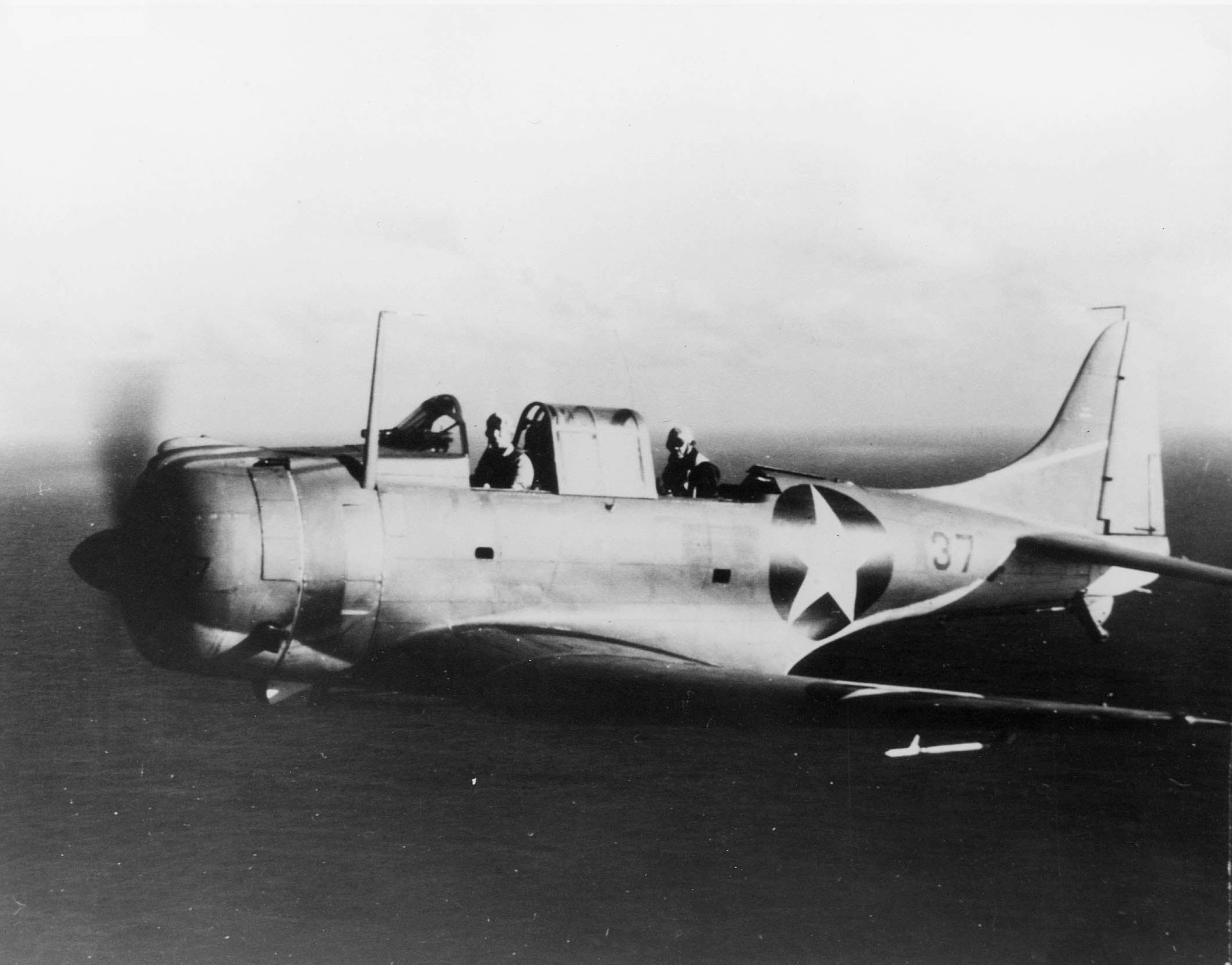
The aircraft flown by Wade McClusky, Max Leslie, and Richard Best helped turn one of the most consequential mornings in American naval history into a decisive victory.
On the morning of June 4, 1942, American naval aviators searched an immense expanse of the Pacific Ocean for an enemy fleet they could not afford to miss. The Japanese striking force approaching Midway possessed formidable aircraft carriers, experienced aircrews, and the ability to deliver another devastating blow against American forces. To stop it, the United States needed more than a capable aircraft. It needed skilled men willing to take that aircraft into a dangerous attack, make critical decisions with incomplete information, and carry out their missions in the face of enemy fire.
Among those men were three members of the Midway Six: Lieutenant Commander C. Wade McClusky, Lieutenant Commander Maxwell F. “Max” Leslie, and Lieutenant Richard H. “Dick” Best. Each played an important role in the American dive-bomber attacks that struck Japan’s carriers that morning. Their aircraft was the Douglas SBD Dauntless, a two-seat scout and dive bomber whose effectiveness at Midway would secure its place in naval aviation history.
The Dauntless is remembered for the damage its bombs inflicted. Its greater story, however, belongs to the aviators who found the enemy, committed themselves to an attack, and returned, when they could, through a sky that remained dangerous long after their bombs were released.
An Aircraft Built for the Demands of Carrier Warfare
The Douglas SBD, short for Scout Bomber Douglas, grew out of an earlier Northrop dive-bomber design and entered Navy and Marine Corps service before the United States entered World War II. Its mission combined reconnaissance with attack. It could search for enemy warships across wide reaches of ocean, then carry a bomb directly against a target that might be moving at considerable speed. That dual role made the SBD especially valuable in a conflict where locating an aircraft carrier could be as important as striking it.
The aircraft had a crew of two: a pilot in the forward cockpit and a radioman-observer who also served as the rear gunner. Its low-wing design, radial engine, carrier landing equipment, and sturdy construction reflected the practical demands of operating from a moving flight deck. The SBD-3, widely used by the carrier squadrons at Midway, incorporated improvements including armor, self-sealing fuel tanks, heavier forward armament, and refinements to the dive-brake system. These developments are documented by the National Naval Aviation Museum’s history of the Dauntless.
The most distinctive feature was its system of perforated split dive brakes. A dive bomber had to descend steeply enough to aim accurately at a maneuvering ship while keeping its speed under control. The Dauntless’s brakes helped its pilot manage that descent. After releasing a bomb, the crew still had to pull out, evade antiaircraft fire, escape enemy fighters, and find the way back to a carrier that might no longer be where it had been at launch.
The SBD could carry a heavy bomb beneath its fuselage, commonly a 1,000-pound weapon for the Midway carrier strikes. Forward-firing .50-caliber machine guns gave the pilot offensive firepower, while flexible rear-mounted .30-caliber guns offered a measure of defense. None of those features made the aircraft invulnerable. What they offered was a fighting chance in the hands of highly trained aviators. The USS Midway Museum’s Dauntless overview describes the design’s characteristics and the precision that its dive brakes made possible.
A Weapon That Demanded Courage and Precision
Dive bombing required skill, discipline, and a willingness to approach an enemy ship directly. From altitude, a pilot had to identify the target, place the aircraft into a steep dive, maintain control while the target maneuvered, release the bomb at the appropriate moment, and recover before reaching the ocean. Meanwhile, enemy guns fired upward and enemy fighters looked for vulnerable aircraft before and after their attacks.
The pilot’s work depended on the man behind him. The observer and gunner helped watch for threats, communicate, and defend the aircraft, especially during the exposed withdrawal from the target area. The Naval History and Heritage Command’s account of rear-seat gunners preserves the importance of that often-overlooked position.
This distinction matters when considering the men of the Midway Six. Their achievement cannot be understood through aircraft performance figures alone. An SBD’s capability on paper said little about the uncertainty of finding a fleet at sea, the exhaustion caused by a long search, the possibility of fuel starvation, or the decisions a squadron leader had to make in seconds.
Wade McClusky: Finding the Japanese Fleet
Lieutenant Commander C. Wade McClusky led the Enterprise air group’s dive-bomber search on June 4. His formation included SBDs from Bombing Squadron Six (VB-6) and Scouting Squadron Six (VS-6). Their intended target was the Japanese carrier force, but when they arrived in the expected area, the ocean appeared empty. The longer the search continued, the greater the danger of exhausting their fuel before they could reach a friendly flight deck.
McClusky continued searching. He then observed a Japanese destroyer moving at speed and reasoned that it might be returning to the carrier force. The ship was Arashi, which had been engaged in action against the American submarine Nautilus. Following the destroyer’s course helped lead the American dive bombers to the Japanese carriers. The Navy’s detailed historical analysis, The Victory, describes the search, the critical fuel situation, and the decision that put the attackers over the enemy fleet.
This was an act of judgment under pressure. McClusky could not know with certainty where the destroyer was headed, and every additional minute increased the danger to his aircraft and crews. Yet the decision placed American SBDs in position for one of the battle’s decisive attacks.
As the Enterprise dive bombers began their attacks, there was confusion over the allocation of targets between Kaga and Akagi. Historians continue to examine exactly how that confusion developed, and the Navy’s account acknowledges differences among later interpretations. What is clear is that the American aircraft inflicted catastrophic damage on Kaga, while a small section of SBDs redirected its attack against Akagi.
Richard Best: The Attack on Akagi
Lieutenant Richard H. “Dick” Best, commanding VB-6, recognized that the attacking Dauntlesses were concentrating on Kaga. He led a three-aircraft section toward Akagi, the flagship of the Japanese carrier force. With little time to reorganize, Best and his wingmen committed to an attack that gave the Japanese carrier no warning sufficient to prevent the damage.
A bomb struck Akagi, penetrating into the ship and igniting destructive fires and explosions. The precise attribution of the direct hit among the three attacking aircraft is debated in some historical accounts, although Best is traditionally credited. The essential historical outcome is undisputed: his section’s attack helped put Akagi out of action. The Naval History and Heritage Command’s discussion of the attack explains both the importance of Best’s decision and the uncertainties in reconstructing individual bomb impacts.
Best’s contribution did not end with that morning’s attack. Later on June 4, he took part in the strike against Hiryu, the fourth Japanese carrier, which had remained operational long enough to launch damaging attacks against USS Yorktown. The afternoon attack left Hiryu fatally damaged. The Navy’s Battle of Midway history records the sequence of strikes and the loss of the Japanese carriers.
Best’s story illustrates the combination of precision and initiative that made the Dauntless effective. The aircraft could deliver the bomb, but a pilot still had to identify the opening and act on it.
Max Leslie: Leading the Strike on Soryu
At nearly the same time, Lieutenant Commander Maxwell F. “Max” Leslie led Bombing Squadron Three (VB-3) from USS Yorktown. His seventeen SBDs approached the Japanese force by a different route from the Enterprise aircraft. Their arrival near the carriers coincided with the American attacks from the south, creating a devastating concentration of pressure on the Japanese force.
Leslie’s squadron faced a serious equipment problem before reaching the target. As the aircraft prepared their bombs for attack, an electrical malfunction caused four SBDs, including Leslie’s, to release their bombs prematurely. The aircraft remained capable of flight, but their pilots had lost the weapons they had been sent to deliver. The malfunction is recorded in USS Yorktown‘s June 18, 1942 action report, which states that four bombs were released when electrical switches were turned on.
Leslie continued to lead the attack. The remaining armed SBDs dived on Soryu, scoring hits that set the carrier ablaze and ended its ability to continue fighting. His decision to remain with his squadron, despite having lost his own bomb, reflected a commander’s duty to lead his men through the attack rather than abandon them at the moment of greatest danger.
The Yorktown action report also documents a troubling detail that could easily disappear from a broader battle narrative: pilots reported that windshields and telescopes fogged during their dives, an equipment problem that had previously been reported. Such limitations serve as reminders that even an effective aircraft depended on imperfect systems and the skill of the people operating them.
The Men Who Went in Before the Dive Bombers
The success of the Dauntless attacks must be understood alongside the terrible cost paid by the American torpedo squadrons. Before and during the arrival of the SBDs, Devastator crews from USS Hornet, USS Enterprise, and USS Yorktown pressed low-altitude attacks against the Japanese carriers. Their formations suffered devastating losses to Japanese fighters and antiaircraft fire.
Three other members of the Midway Six, John Waldron, Eugene Lindsey, and Lance Massey, led torpedo-bomber squadrons into those attacks. Their courage and sacrifice form an inseparable part of this story. The Japanese combat air patrol was heavily engaged at low altitude as the dive bombers approached from above, although the precise relationship between the attacks involved timing, visibility, Japanese defensive responses, and the movements of multiple American formations. The Navy’s battle summary records the sequence and the extreme losses among the torpedo crews.
The torpedo squadrons did not have to know how events would unfold to demonstrate their valor. They attacked under extraordinary conditions because their mission demanded it. Their losses should never be reduced to a convenient prelude to the dive bombers’ success. They were fighting men carrying out their own assigned attacks, and the larger victory belongs to all who served and sacrificed.
Minutes That Changed the Pacific War
In a matter of minutes on the morning of June 4, American dive bombers struck Kaga, Akagi, and Soryu. Fires, explosions, and damage to aircraft and fueling systems left all three carriers beyond recovery. Hiryu continued to fight, and her aircraft inflicted serious damage on Yorktown, but American SBDs attacked and fatally damaged Hiryu later that afternoon. Japan ultimately lost all four carriers of the striking force that had attacked Midway.
The victory came at a price. American aircraft and crews were lost, Yorktown suffered mortal damage, and the aftermath left families across the country awaiting news that would change their lives forever. The Dauntless earned its reputation in the battle, but its accomplishments cannot be separated from the wider effort of naval aviators, shipboard crews, intelligence personnel, submariners, Marines, and all the men who held their positions when the outcome was uncertain.
The Navy’s contemporary combat narrative provides a valuable period account of the strikes and their immediate effects. As with many wartime reports, some details and damage assessments were later refined by postwar research. What has endured is the significance of the victory and the service of the men who made it possible.
The Dauntless Legacy and the Midway Six
Today the SBD Dauntless stands among the most recognized American aircraft of the Pacific War. Its practical design, effective dive brakes, and bomb-carrying ability made it a formidable weapon against enemy warships. A surviving SBD-2 associated with the battle is preserved by the National Naval Aviation Museum, providing a tangible connection to the aircraft and the men who flew it.
For Honor American Heroes, the Dauntless represents something greater than an achievement of aviation engineering. It connects the stories of Wade McClusky, Max Leslie, and Richard Best to the courage of John Waldron, Eugene Lindsey, Lance Massey, and the many others who fought that day. Their missions were different, their circumstances were different, and the outcomes for their crews were tragically unequal. Each answered the call to serve when the nation’s future demanded extraordinary resolve.
The aircraft helped change the course of the Battle of Midway. The valor, judgment, perseverance, and sacrifice of the Americans who flew and supported it gave that aircraft its place in history. Remembering them means preserving both the extraordinary outcome of the battle and the human lives behind it.
Historical Sources and Further Reading
- Naval History and Heritage Command: Battle of Midway
- Naval History and Heritage Command: H-Gram 006, The Victory
- Naval History and Heritage Command: Battle of Midway Combat Narrative
- National Naval Aviation Museum: SBD Dauntless, BuNo 2106
- USS Yorktown Action Report, June 18, 1942
- USS Midway Museum: SBD Dauntless
Leave a Reply